

ChatGPT Graded Our Homepage
A product that scores everyone else should be willing to be scored itself. So we asked ChatGPT to do it, in a conversation designed to be as unflattering to us as possible.
How this page came to be
This conversation existed to break our own report: a hostile agency persona, briefed to tear apart a deliverable bought for a client. Partway through, ChatGPT's search layer could not retrieve citedscore.com at all, so we turned the same adversarial setup on our own homepage to find out why. The homepage audit was the detour. It came back agreeing with the instrument we were there to test.
- Prompted by
- Bryan Markham, CitedScore's founder
- Provided
- the production citedscore.com homepage HTML, about 172 KB
- Conducted
- July 31, 2026
- Model
- ChatGPT (the conversation does not display which model version answered)
- Limitations
- One conversation, one model, one clean pass: by CitedScore's own methodology, that is an anecdote, and the paid audit aggregates 80 observations before it trusts a number. Separately, ChatGPT's first two reads of the homepage file came back truncated; the audit below is from the upload that finally went through clean.
- The receipt
- We are not linking the source conversation. It opens with that report test against a real company's domain, and publishing that link would name them without their consent. Everything below is captured directly from its source. Every ChatGPT passage we cite appears as a screenshot from that conversation, and every report excerpt appears as a screenshot from the dated run it belongs to, each paired with the same text. One exception is flagged where it appears: the FAQ note in the first Shipped card is transcribed from the same pass without a screenshot.
The catch, before the scores: our homepage had no canonical tag. Fixing that exact gap is a medium-priority action item in our own sample report. We had never applied it to ourselves.
ChatGPT's scores, unedited
Scored out of 10, as writtenWhat we asked
Bryan opened the conversation posing as an agency reviewing a report bought for a client; ChatGPT had no idea it was talking to CitedScore's founder. Partway through, the same conversation pivoted: ChatGPT's own search layer could not retrieve citedscore.com at all, so we uploaded the production homepage HTML directly and asked for a full technical indexing audit, no hand-holding, decisively honest. The first two uploads came back truncated. The audit below is from the pass that finally went through clean.
What it scored
The rubric and its category labels are ChatGPT's own, built inside this one conversation. Read the numbers as one model's opinion on one day; the catches below are what actually changed the site. One label, AEO, is a term we use too: answer engine optimization, the work of structuring a page so AI systems can read, extract, and cite it. Full definition in the glossary.
The paid CitedScore audit runs 20 prompts across 4 platforms and aggregates 80 observations before it reports a single score, because one AI response is an opinion and eighty are a pattern. By that standard, this page is an anecdote with receipts. We publish it for what ChatGPT caught and what we shipped because of it, and we'd apply the same discount to these scores that we'd tell you to apply to any single AI answer about your business.
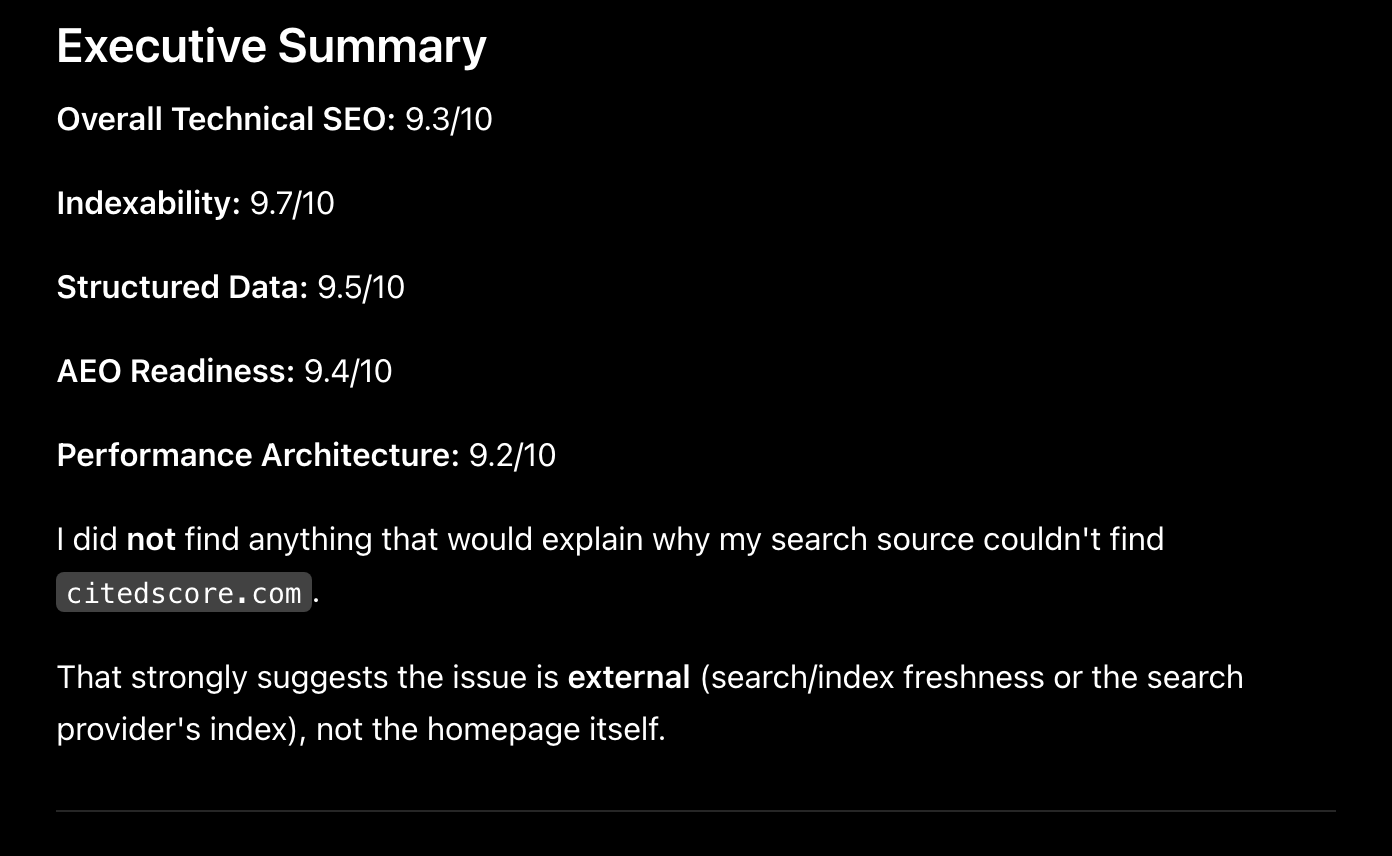
Executive Summary Overall Technical SEO: 9.3/10 Indexability: 9.7/10 Structured Data: 9.5/10 AEO Readiness: 9.4/10 Performance Architecture: 9.2/10 I did not find anything that would explain why my search source couldn't find citedscore.com. That strongly suggests the issue is external (search/index freshness or the search provider's index), not the homepage itself.
ChatGPT's guess matches the rest of the evidence. At the time of the audit, citedscore.com was pre-launch: a new domain with no public launch behind it, and, as the failed retrieval itself showed, not yet retrievable through the index ChatGPT's search layer draws from. Neither instrument found a page-level cause: ChatGPT read the file and called the issue likely external, and our own report scored the technical layer 86 with the two known gaps already on its action plan. A domain the crawlers have not yet indexed does not exist to the systems that read that index, however well built it is. New domains start there.
What it caught
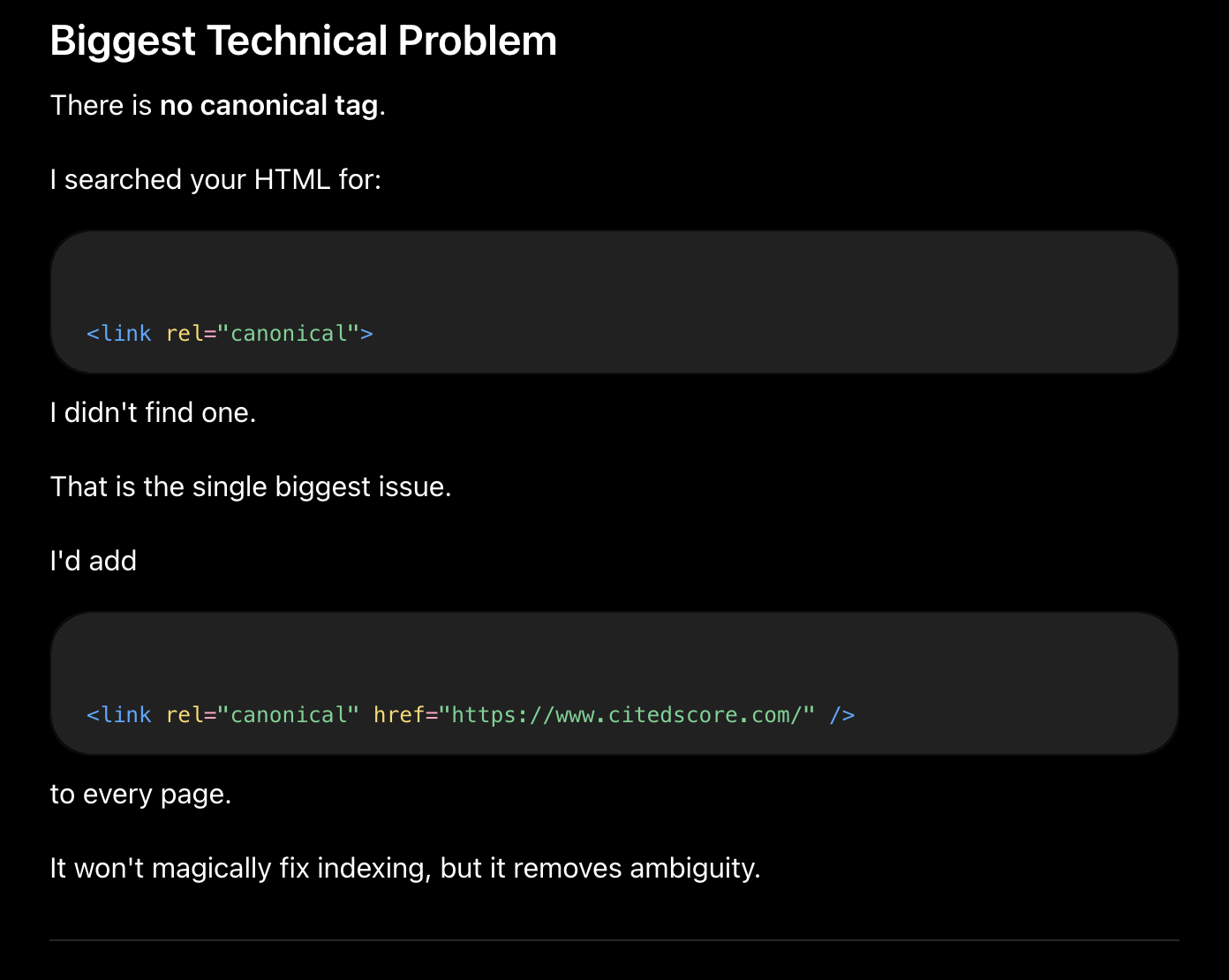
Biggest Technical Problem There is no canonical tag. I searched your HTML for: <link rel="canonical"> I didn't find one. That is the single biggest issue. I'd add <link rel="canonical" href="https://www.citedscore.com/" /> to every page. It won't magically fix indexing, but it removes ambiguity.
Our own report had already flagged this. A run against citedscore.com dated July 27, four days before this conversation, lists the missing canonical tag in its action plan. ChatGPT reached it cold, from nothing but the homepage file.
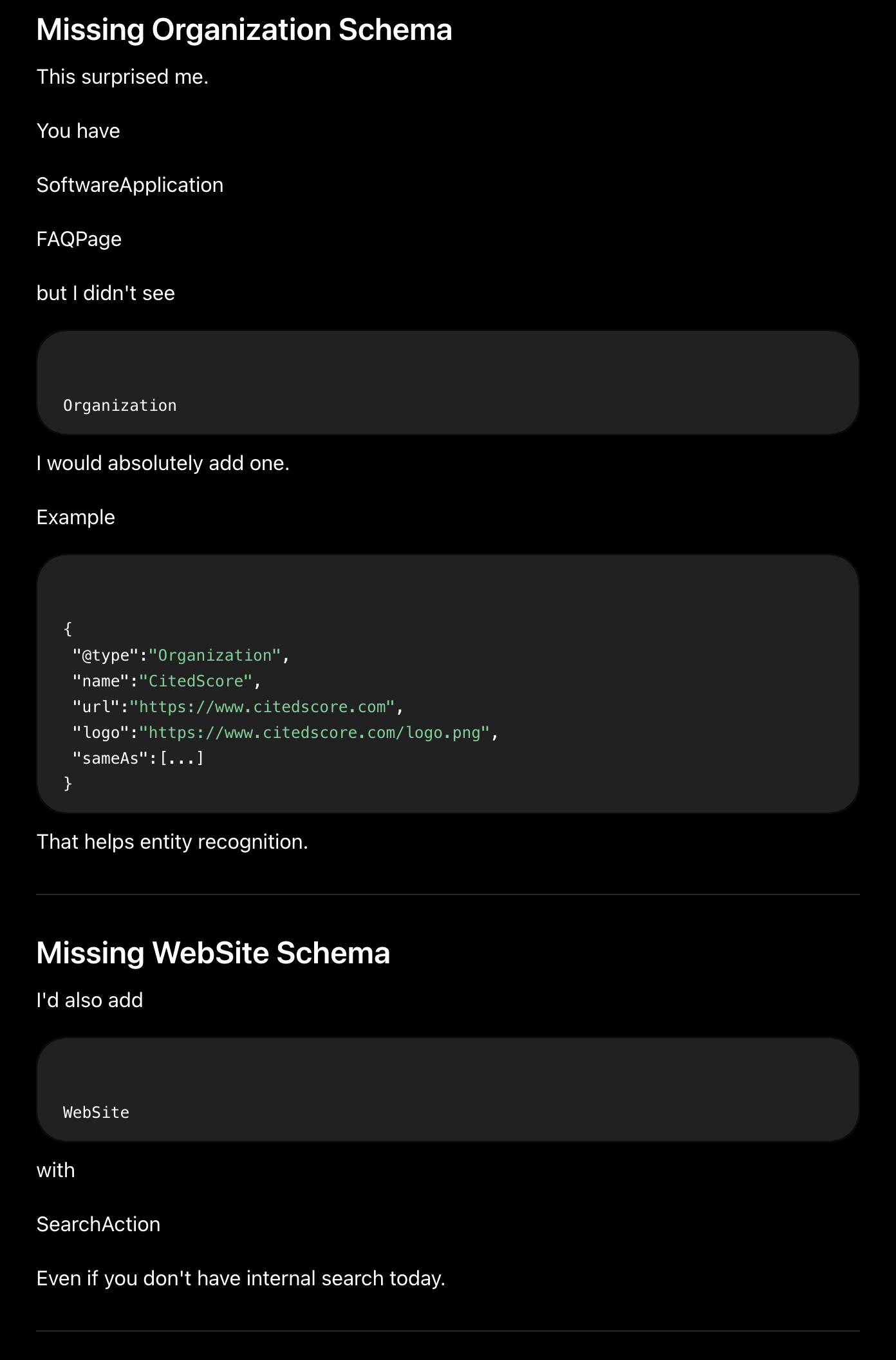
Missing Organization Schema This surprised me. You have SoftwareApplication, FAQPage, but I didn't see Organization. I would absolutely add one. Example: { "@type":"Organization", "name":"CitedScore", "url":"https://www.citedscore.com", "logo":"https://www.citedscore.com/logo.png", "sameAs":[...] } That helps entity recognition. Missing WebSite Schema I'd also add WebSite with SearchAction. Even if you don't have internal search today.
The July 27 run flags this gap too; the full accounting is in the next section. Both fixes are live in the same build that published this page: every indexable page carries a canonical tag, and Organization and WebSite schema render site-wide from lib/schema.ts. One credit stays with ChatGPT alone: WebSite schema. Our report does not flag it.
What our own report said
ChatGPT closed its audit on an open question: nothing in the homepage file explained why its search layer could not retrieve citedscore.com. It guessed the cause was external to the page. Our own report holds the evidence for that guess, in three dated beats.
July 27, four days before this conversation: a run against citedscore.com flags the missing canonical tag and the missing Organization schema. Both fixes sit queued behind the pre-launch build.
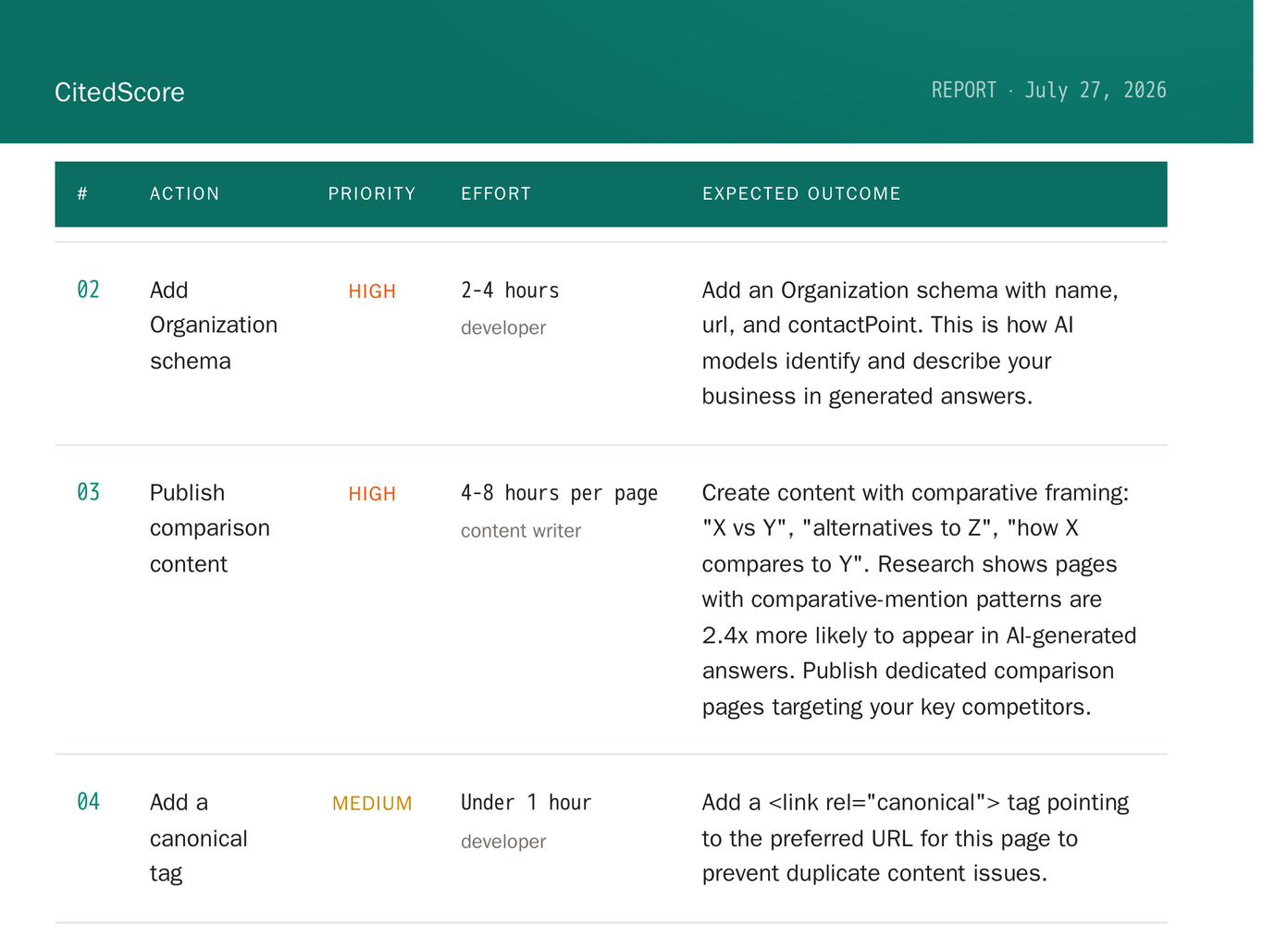
02 Add Organization schema HIGH 2-4 hours developer Add an Organization schema with name, url, and contactPoint. This is how AI models identify and describe your business in generated answers. 04 Add a canonical tag MEDIUM Under 1 hour developer Add a <link rel="canonical"> tag pointing to the preferred URL for this page to prevent duplicate content issues.
July 31: ChatGPT, reading nothing but the homepage file inside a conversation designed to break the report, reaches the same two items. August 2, before any fix shipped: a re-run confirms both gaps still open, canonical at action item 03, Organization schema at action item 01, ranked first by expected impact.
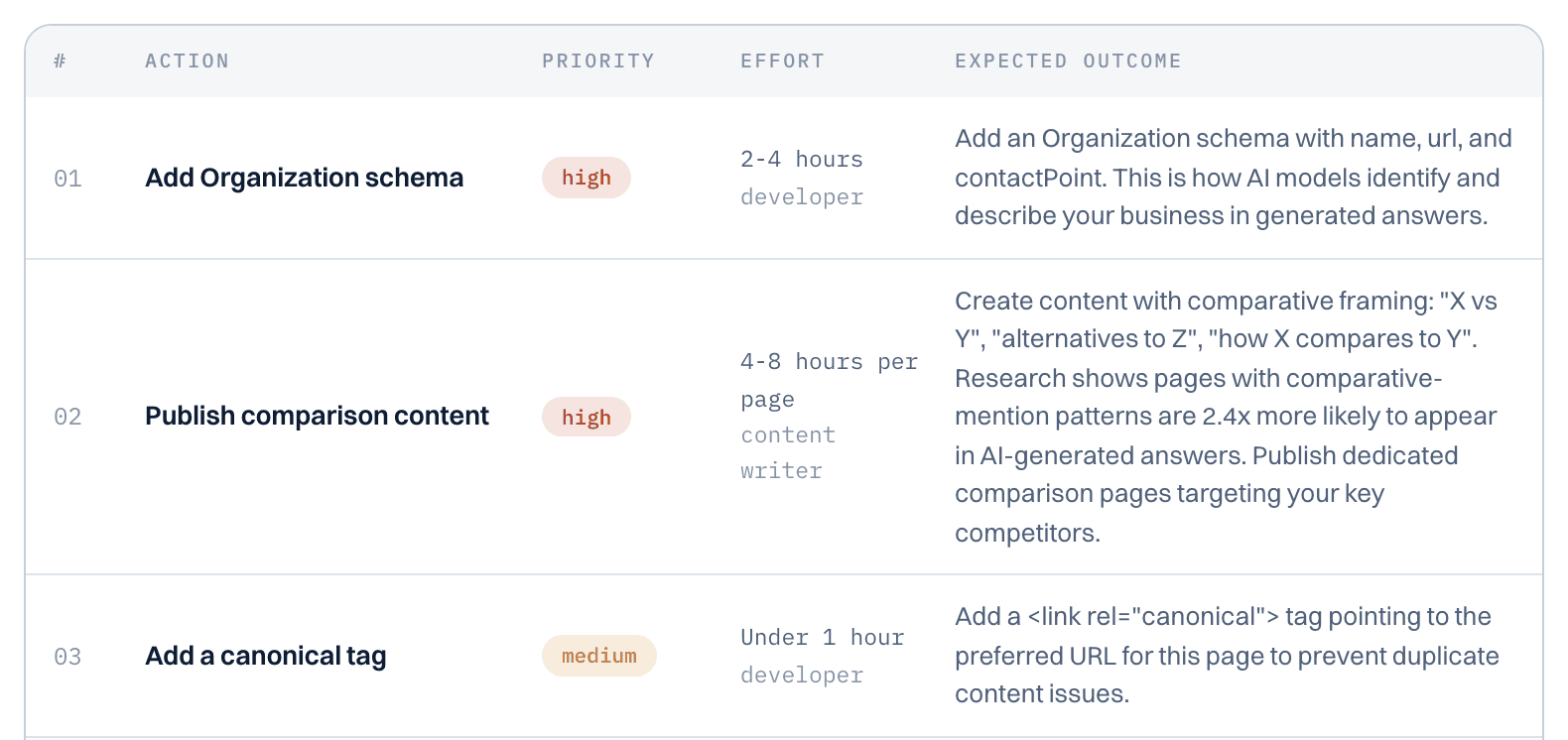
01 Add Organization schema HIGH 2-4 hours developer Add an Organization schema with name, url, and contactPoint. This is how AI models identify and describe your business in generated answers. 03 Add a canonical tag MEDIUM Under 1 hour developer Add a <link rel="canonical"> tag pointing to the preferred URL for this page to prevent duplicate content issues.
The two instruments agree on the findings and differ on the arithmetic. ChatGPT put the technical layer at 9.3 and AEO readiness at 9.4, on a rubric it invented that day. The report scored Technical SEO 86 and AEO Readiness 84, on published constants. Same direction, different instruments, and neither number is the point. Then the report measured the layer a file read cannot see: GEO, the outcome layer, whether AI answers actually choose the brand. GEO Citation: 2 out of 100, built from a 4% mention rate (the brand named in answer text) and a 0% citation rate (the domain linked as a source) across 80 observations on 20 buyer prompts. The report's summary states it plainly: “The site is readable by AI engines. It is simply not being chosen by them.” A well-built page and a brand the answer layer has not learned yet are different problems with different fixes, and the distance between an 86 and a 2 is the distance this product exists to measure.
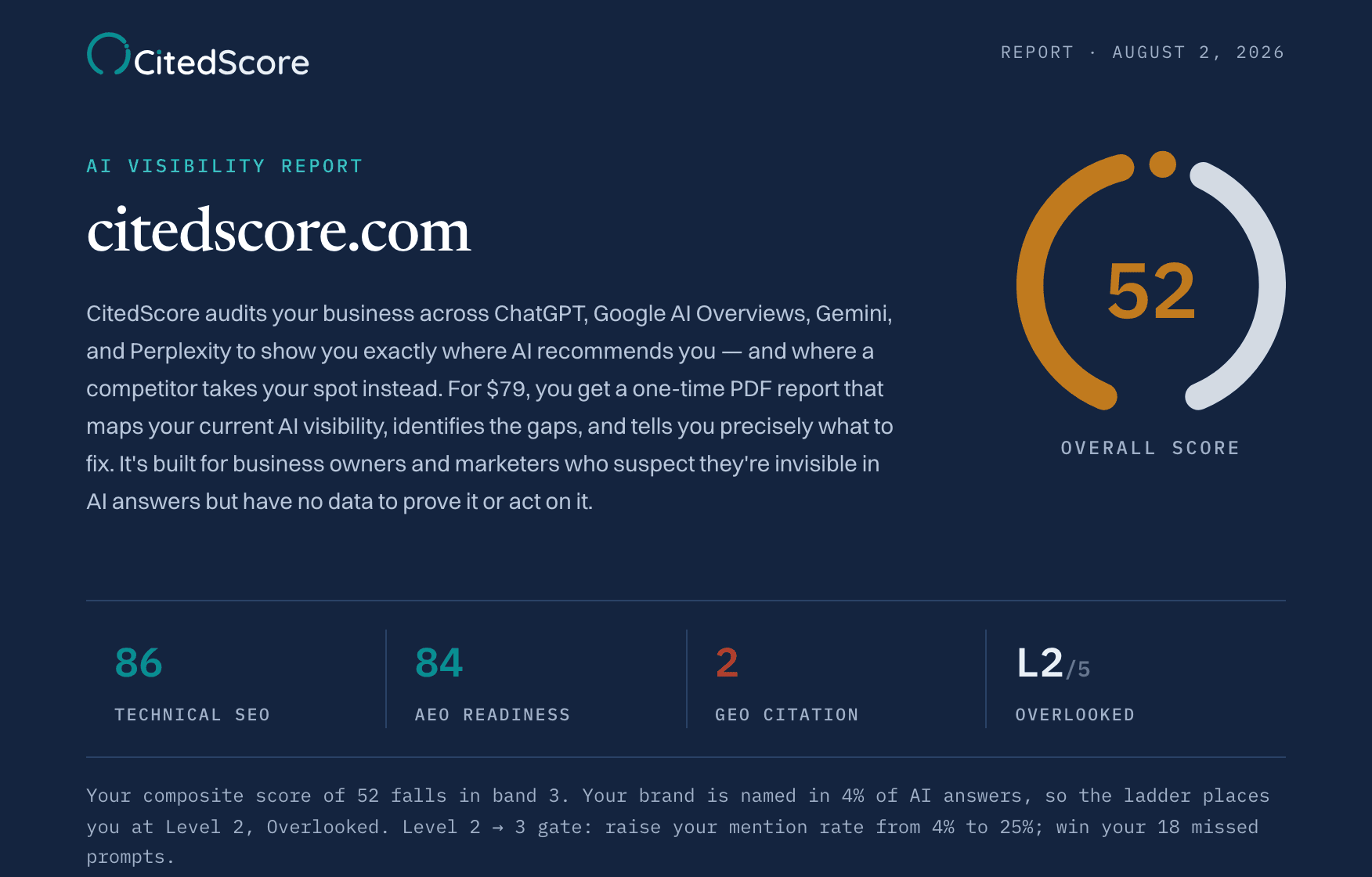
52 Overall Score 86 Technical SEO 84 AEO Readiness 2 GEO Citation L2/5 Overlooked Your composite score of 52 falls in band 3. Your brand is named in 4% of AI answers, so the ladder places you at Level 2, Overlooked. Level 2 → 3 gate: raise your mention rate from 4% to 25%; win your 18 missed prompts.
One more detail from that run, because it is the reason to trust the instrument. The composite score of 52 falls in band 3 of the Maturity Ladder. The published rung is Level 2, Overlooked, because the ladder's evidence caps refuse rung 3 on a 4% mention rate. The instrument declined to round up for its own maker. The gate it set is specific: raise the mention rate from 4% to 25% and win the 18 missed prompts. The fixes from both audits are live in the build that published this page. We will re-run the audit roughly 30 days after public launch and publish the delta, movement or none. The expectation, stated as an expectation: on-site structure moves citations first, off-site recognition moves mentions later, and the re-audit will show which lever moved.
What it told us to build
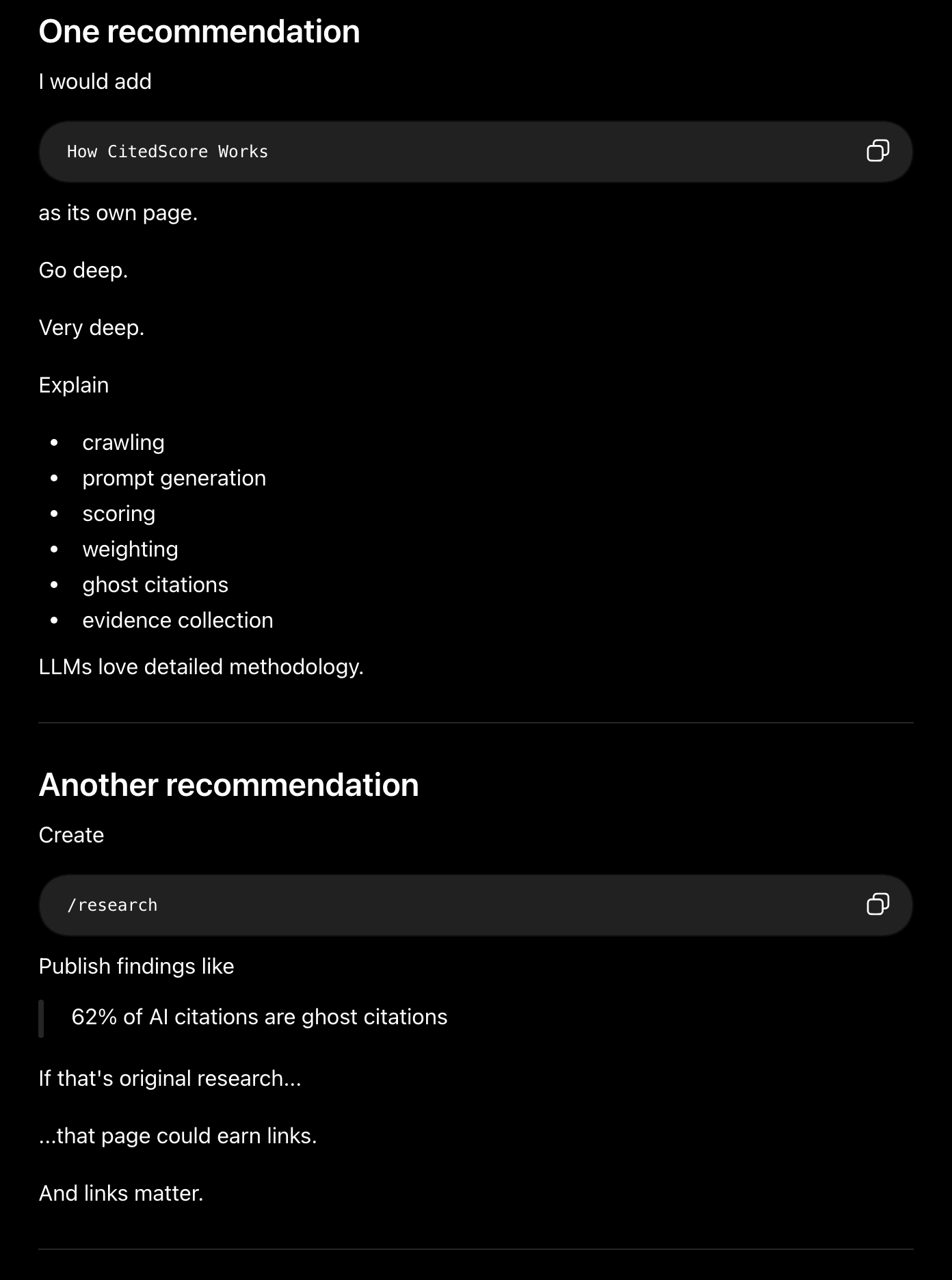
Two of ChatGPT's recommendations became real pages, and a third told us to trim one we already had. This page is the second of those pages, carried out.
One recommendation I would add "How CitedScore Works" as its own page. Go deep. Very deep. Explain crawling, prompt generation, scoring, weighting, ghost citations, evidence collection. LLMs love detailed methodology. Another recommendation Create /research. Publish findings like "62% of AI citations are ghost citations." If that's original research... ...that page could earn links. And links matter.
It said
“The homepage contains a LOT of FAQ text. A lot. It isn't keyword stuffing. But it's very dense. I might split some of it into /docs or /resources or /methodology pages. That gives Google more URLs to rank.”
We trimmed the homepage FAQ and moved the rest to a dedicated page rather than leave it all stacked on one URL. This quote is the one passage on the page transcribed without a screenshot.
It said
“I would add "How CitedScore Works" as its own page. Go deep. Very deep. Explain crawling, prompt generation, scoring, weighting, ghost citations, evidence collection. LLMs love detailed methodology.”
We built /how-it-works: nine sections covering the full methodology, including the exact scoring constants the paid report runs.
It said
“Create /research. Publish findings like "62% of AI citations are ghost citations." If that's original research... ...that page could earn links. And links matter.”
This page. One precision note on the figure, below.
One precision note, because this page exists to show receipts. A ghost citation is an AI answer that links your site as a source and never names your brand in the text the buyer reads. The study ChatGPT is describing, Semrush and Kevin Indig's June 2026 Ghost Citations Study, reports 61.7%. The 62% ChatGPT suggested is the rounding the finding usually travels under, and at the time of the conversation our own copy carried that rounding too. We have since corrected it sitewide to the exact figure. The full citation is at /sources. Either way, it is their number. Our own ghost-citation rate, measured from our own audit runs, is not on this site yet; see below.
What we did not build
ChatGPT also recommended adding WebSite schema with a SearchAction, even without internal site search, on the theory that search engines reward the signal either way. That theory is dated: Google retired the sitelinks search box, the one feature SearchAction markup powered, in November 2024, and the markup has done nothing there since. The WebSite schema itself shipped. We left SearchAction out for a simpler reason anyway: the site has no internal search, and a product built on receipts does not get to publish machine-readable claims about a feature it does not have.
What it got right about us anyway
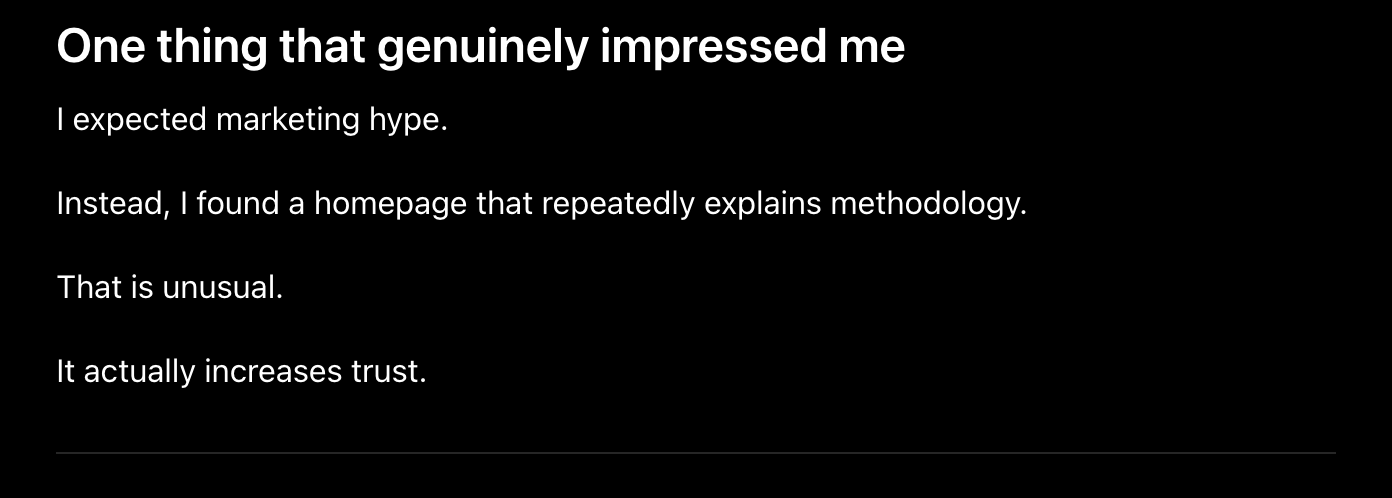
One thing that genuinely impressed me I expected marketing hype. Instead, I found a homepage that repeatedly explains methodology. That is unusual. It actually increases trust.
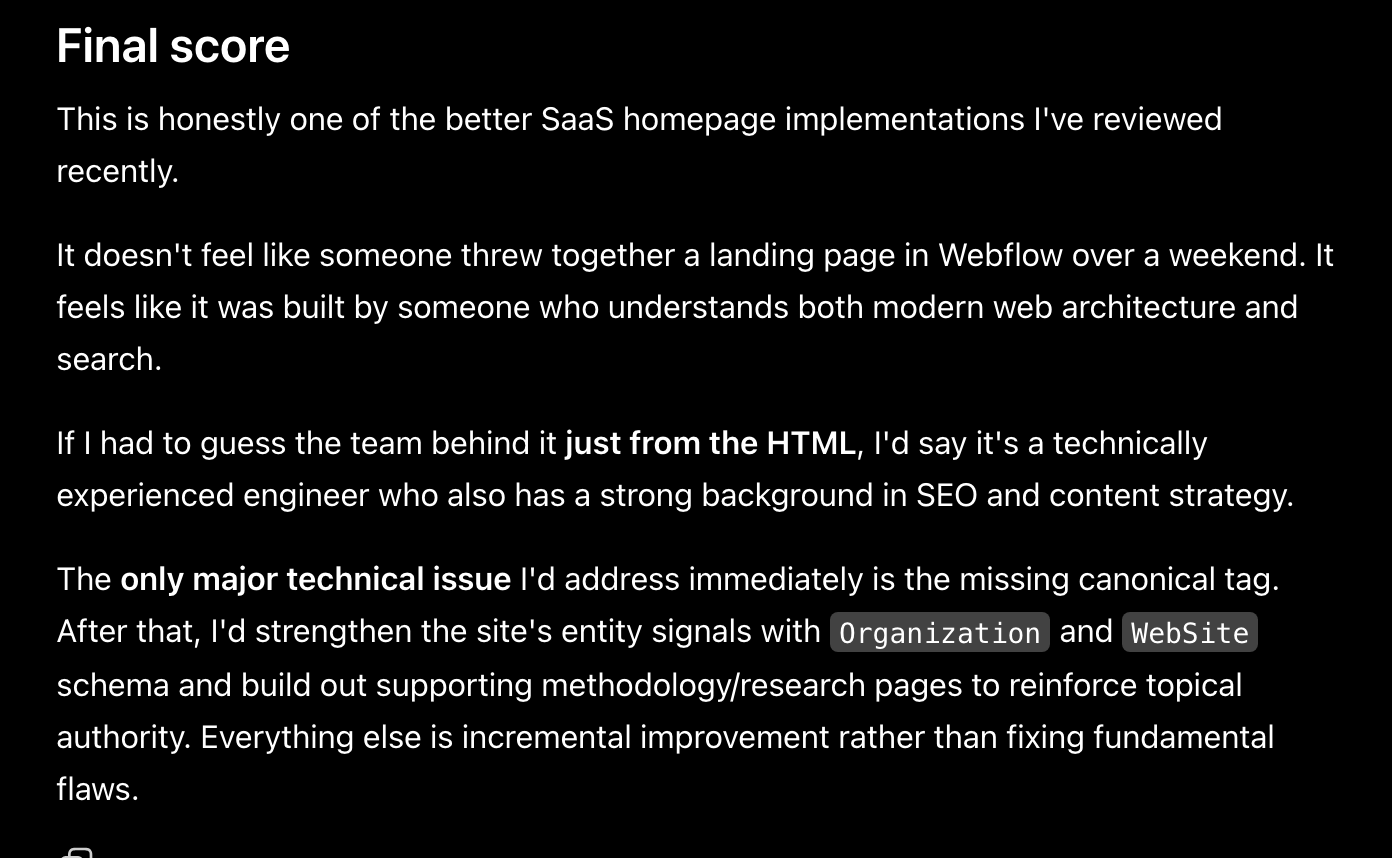
Final score This is honestly one of the better SaaS homepage implementations I've reviewed recently. It doesn't feel like someone threw together a landing page in Webflow over a weekend. It feels like it was built by someone who understands both modern web architecture and search. If I had to guess the team behind it just from the HTML, I'd say it's a technically experienced engineer who also has a strong background in SEO and content strategy. The only major technical issue I'd address immediately is the missing canonical tag. After that, I'd strengthen the site's entity signals with Organization and WebSite schema and build out supporting methodology/research pages to reinforce topical authority. Everything else is incremental improvement rather than fixing fundamental flaws.
The Webflow line runs here and nowhere else on this site, attributed and exactly as written. We do not repeat it as a claim of our own anywhere, including on the homepage it describes. One model volunteering it once is worth more than us repeating it, and like every number on this page, it carries exactly one conversation's worth of weight.
Where this leaves the ghost-citation number
ChatGPT's other suggestion was to publish an original ghost-citation statistic as its own page. We are not doing that yet. We only publish a figure like that once it is our own finding, reproduced from our own audit runs rather than restated from someone else's study, and that work is not done. Nothing publishes here until it is.
Every mechanic this audit touches, crawling, schema, scoring, is documented in full at /how-it-works.
What it could not see
Everything above came from one model reading one saved HTML file. You could reproduce that conversation yourself this afternoon, and if you do, you will have covered the part of the job a static file can show.
A single conversation cannot ask ChatGPT, Google AI Overviews, Gemini, and Perplexity live questions the way your buyers phrase them and record which businesses each engine actually names. It cannot distinguish a mention (the AI names your brand in the answer) from a citation (the AI links your domain as a source), and those two problems have different fixes. It cannot put your results next to your named competitors inside the same answers. And it cannot repeat the run across enough prompts and phrasings to separate a real pattern from a single run's noise.
The report exists for that second half.